How to check a property before buying
A property purchase is the biggest transaction of many people's lives, but the costliest problems (hidden encumbrances, a seller without full rights, a red-disc building, land you cannot build on) are not visible at a viewing. Below is the complete checklist for before paying a deposit and before signing, with the official source for confirming each item.
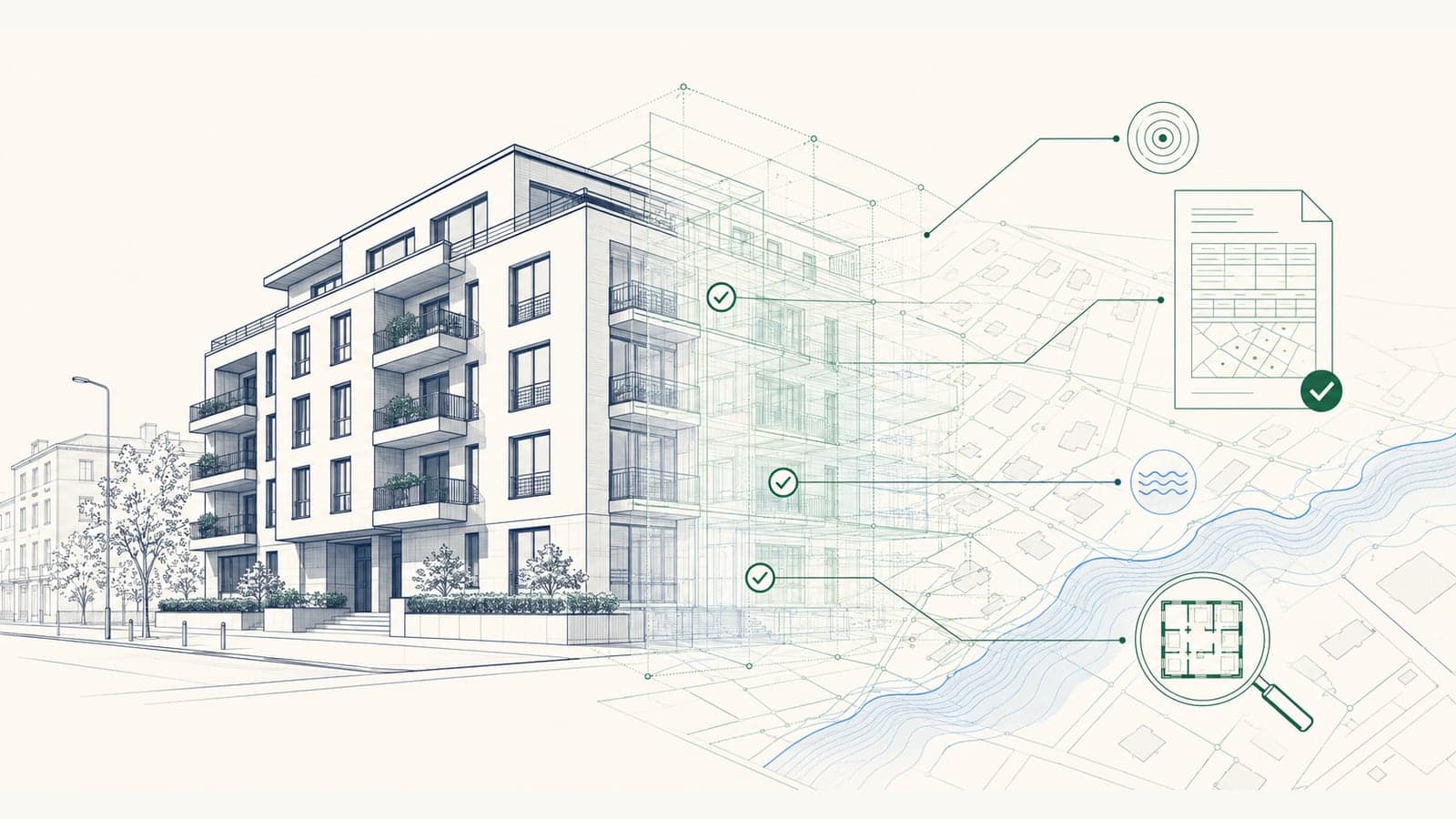
Before buying a property in Romania, check 8 things. The land register extract (owner plus encumbrances) is the minimum check before paying a deposit:
- Ownership documents and land registration (the property has a land register entry).
- The actual owner, from Part II of the land register extract.
- Encumbrances in Part III: mortgages, prohibitions, attachments, litigation.
- Area and cadastral number, which must match the documents.
- Planning status: what can be built (PUZ, POT, CUT).
- Area risks: seismic, flooding, environment.
- Debts: tax clearance certificate and owners' association certificate.
- Actual value, compared with the 2026 notarial valuation grid.
What to check, in brief
Property checks have three stages: before the deposit (when you risk the most money), before signing (when you reconfirm that nothing has changed) and for land/old houses (where additional checks arise). The list below runs from what protects you most to what you budget for at the end.
1. Ownership documents and land registration
Start with the land register extract - the official ANCPI document showing the property's legal status. Confirm that the property is registered and that the extract's details match the seller's title deed and the listing.
- the property has a land register entry (it is registered);
- the type matches (flat, house, land);
- the seller's acquisition deed exists and is valid.
2. The actual owner
The name in Part II of the extract must match the person you are negotiating with. If there are multiple owners or the property is held under a community property regime, everyone must sign.
- the documented owner = the seller;
- all co-owners agree and sign;
- if the seller is a company, check its status (insolvency, debts): check the seller.
3. Encumbrances, mortgages and litigation
Part III of the extract is the most important for a buyer. It shows mortgages, prohibitions, attachments and recorded litigation.
- Mortgage - it can be discharged at the transaction (the seller's loan is repaid from the price), but this must be planned with the bank;
- Prohibition on disposal / attachment - blocks the sale; a red flag;
- Litigation notice - do not sign anything without legal advice (see what a litigation notice means).
4. Area and cadastral number
The cadastral number and area in the extract must match those in the listing and the contract you are about to sign exactly. A different cadastral number or an area that does not match are indicators requiring clarification before paying a deposit. Starting from an address? See how to find the cadastral number.
5. Planning and permits
Particularly relevant for land and houses. Check what can be built and whether restrictions apply.
- urban planning certificate, PUG/PUZ, POT and CUT - what and how much you can build;
- existing buildings have permits and are registered (no unauthorised buildings);
- for agricultural/forest land, check pre-emption rights.
6. Risks: seismic, flooding, environment
Area risks do not appear in the land register extract, but affect safety and value. Check:
- the building's seismic risk class (red disc);
- flood zones and flood risk;
- surrounding air quality, noise and waste.
7. Debts: tax and maintenance
Before signing, confirm the property does not come with debts:
- tax clearance certificate from the council - no local tax arrears. From 2026 (OUG 7/2026), the tax clearance certificate is required for the buyer as well as the seller: see the dedicated guide;
- owners' association certificate - no maintenance or repair fund arrears;
- utilities (electricity, gas, water) are paid up to date.
8. Actual value vs the notarial valuation grid
Finally, budget for costs and the value on which charges are based:
- the total cost of buying (deposit, notary, commission, insurance, mortgage payment);
- the minimum notarial valuation grid value - the basis for charges, also useful as a benchmark for whether the asking price makes sense;
- notarial costs (fee, ANCPI, extract).
Special checks, depending on the property
Beyond the basic checklist, some situations require additional checks:
- Old house or block of flats - seismic risk class and whether it is a historic monument or in a protected area (approvals and renovation restrictions);
- Land - hidden risks, access easements and overlaps in the cadastral plan;
- Unsettled inheritance - if the seller inherited the property, succession proceedings must be completed and the seller registered as owner before the sale (see succession costs);
- Company seller - debts, insolvency and litigation that could block or invalidate the transaction.
Where to check each item (and who brings them all together)
Each check has a different official source, scattered across dozens of institutions. You can do them yourself, one by one. Verifi aggregates them all in a single report, with the source and coverage clearly identified for each.
| What to check | Official source | Cost | How long it takes | In the Verifi report |
|---|---|---|---|---|
| Owner and encumbrances (mortgages, litigation) | Land register extract - ANCPI | 60 RON | minute - ore | Yes |
| Minimum notarial value | 2026 notarial valuation grid | gratuit / calcul | instant | Yes |
| The seller (debts, companies, insolvency) | ANAF, ONRC, BPI, Portal Just | 89 RON | ore | Yes |
| Seismic risk (red disc) | INFP, AMCCRS / MDLPA | free but scattered | ore | Yes |
| Flood zones | INHGA (hazard maps) | free but technical | ore | Yes |
| Environment (air, noise, waste) | ANPM, EEA | free but scattered | ore | Yes |
| Cadastral overlaps, actual boundaries | Cadastral plan on an orthophotomap | 48 RON | ore | Yes |
| Agricultural pre-emption | MADR / DAJ - Legea 17/2014 | free but complex | zile | Yes |
| Urbanism (PUZ, POT, CUT) | Local council - urban planning certificate | fee + time | days - weeks | Context |
| All of the above, in one place | Verifi report | one report | minutes | Yes |
Individual costs are indicative (2026). Planning remains a check with the local council; the report flags the context, but you request the urban planning certificate directly.
How much property checks cost and how long they take
Basic checks are inexpensive, but scattered. The land register extract costs 60 RON and arrives within minutes to hours. Many sources (the notarial valuation grid, red-disc lists, seismic and flood risk maps) are free, but spread across dozens of institutions and in technical formats. A complete manual check may take several days of searching separate portals. A report bringing everything together, with each source identified, does it in minutes from the address or cadastral number.
Frequently asked questions
What must I check before paying a deposit?
The land register extract: the actual owner (Part II) and encumbrances in Part III (mortgage, prohibitions, litigation). Pay a deposit only after these have been confirmed.
How much does it cost to check a flat before buying?
Basic checks are inexpensive: through Verifi, the official land register extract costs 60 RON, while many sources (the notarial valuation grid, red-disc lists, risk maps) are free but scattered across dozens of institutions. Verifi products have their final price published before checkout.
Who checks the property?
You can do many checks yourself: land register extract, tax clearance certificate, owners' association certificate. The notary checks documents at signing, but not area risks or debts. For a complete picture in one place, with the source of each check, you can use the Verifi report.
Can a property be checked online?
Yes. The land register extract, notarial valuation grid value, seismic risk class, flood zones and tax status of a company seller can be checked online. Verifi aggregates these from an address or cadastral number, directly on the map.
Is the initial extract still valid at signing?
The position may change in the meantime (a new mortgage, a notice). That is why you check an updated extract immediately before the final deed, not just at the start of negotiations.
What additional checks are needed for an old house or land?
For an old house: the seismic risk class and whether it is a historic monument or in a protected area (restrictions and approvals). For land: pre-emption rights for agricultural/forest land, access easements, cadastral overlaps and what can be built.
Doesn't the notary already check everything?
The notary checks the parties' identity and documents at signing and requests the land register extract for authentication. They do not check seismic risk, flooding, maintenance arrears, the seller's history or whether the price makes sense. Those checks remain the buyer's responsibility, ideally before paying a deposit.