Seismic risk class: what it means and how to check the building before buying a flat
If you are considering a flat in București and the block was built before 1977, its seismic class is probably the most important information to have before signing. This guide explains what RS I, II, III and IV mean, how to check and how to decide.
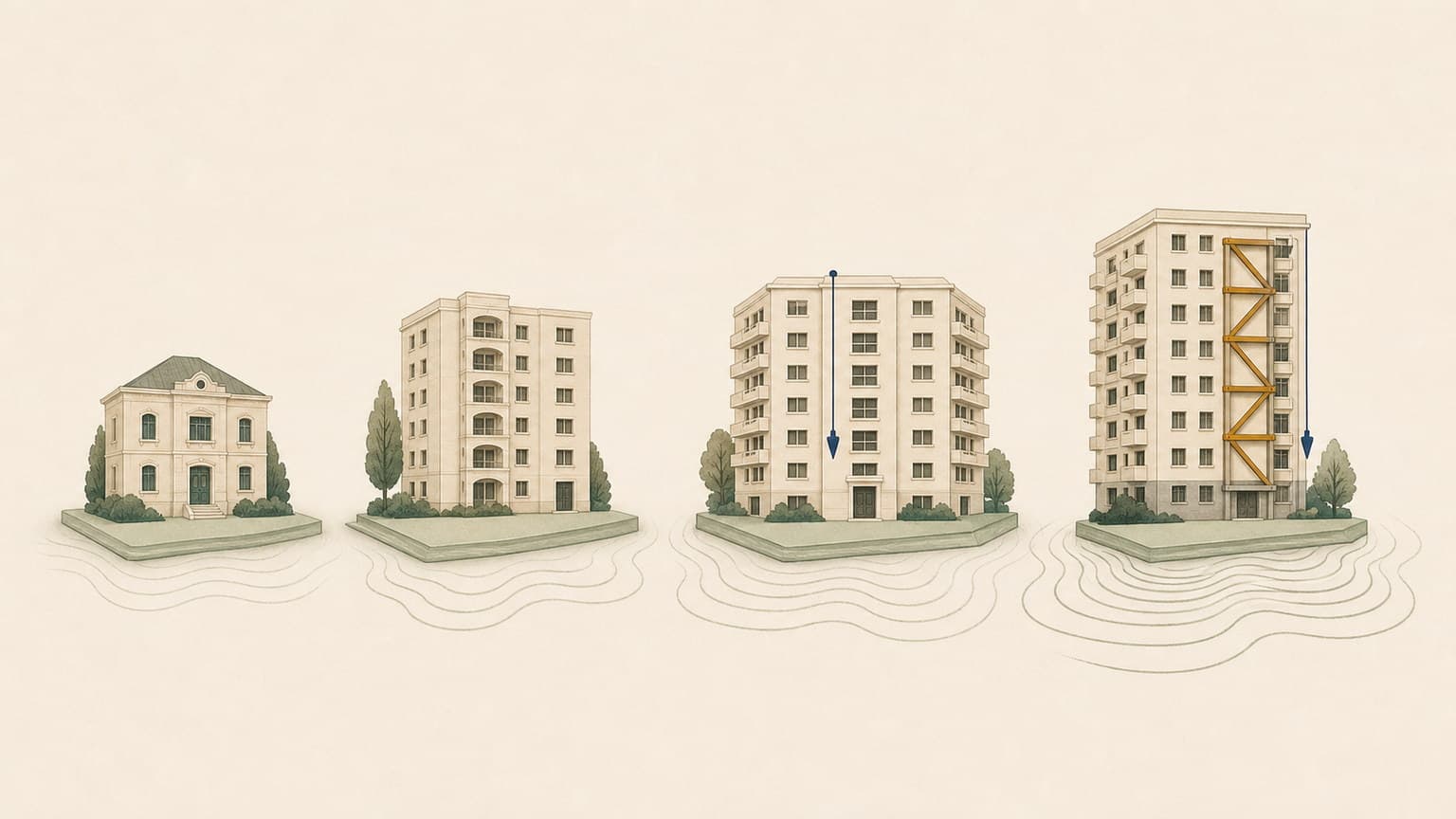
- The RS I-IV classification measures the risk of collapse or structural damage in a major earthquake and is issued by authorised technical experts.
- RS I = high collapse risk, RS IV = acceptable safety. RS II and RS III must be read in the context of the building, assessment and strengthening plans.
- In București, 33 buildings are classified RS I and unstrengthened in 2026, and strengthening costs 40-60% of a flat's value.
- Check through MDLPA, AMCCRS for București, or automatically in the Verifi Standard report (179 RON).
How to interpret the risk class
The seismic class must be read alongside the assessment, year of construction, alterations and your decision to live in the property or invest.
Verifi helps you prepare the right questions and identify important warning signs. For complex legal situations, clarify the decision to sign with your notary or lawyer.
The seismic class must be placed in the context of the building
Do not compare labels alone. Look at the assessment, year, structure, alterations and purpose of the purchase.
An initial check does not replace a technical assessment when the risk is significant.
- RsI-RsIV - seismic risk classes, established by a technical assessment carried out under code P100-3 (Legea 212/2022)
- Letting prohibited - for buildings classified RsI; existing contracts end by operation of law 30 days after classification (art. 5, Legea 212/2022)
- 130 lei/year - the PAD premium for type A homes, with an insured sum of 100,000 lei; it can also be taken out for RsI buildings (Legea 115/2023)
What the RS I-IV classification is
The seismic risk class (abbreviated RS) is a technical classification measuring a building's vulnerability to a major earthquake. It is established through a technical assessment by a certified expert under standard P100-3 on the seismic assessment of existing buildings.
There are four official classes:
- RS I - high risk of partial or total collapse in a major earthquake, a danger to human life.
- RS II - risk of major damage that may cause substantial economic losses and requires strengthening.
- RS III - satisfactory performance, repairable damage in a major earthquake.
- RS IV - good performance, acceptable safety.
The classification attaches to the building, not the individual flat. If the block is RS II, every flat in it is in an RS II building.
Who issues the classification
There are two layers of authority:
The certified technical expert
A structural engineer certified by MDLPA (formerly MDRAP) carries out the on-site assessment, performs calculations and issues the assessment report. The expert proposes the building's risk class.
MDLPA - the national register
Ministerul Dezvoltării, Lucrărilor Publice și Administrației (MDLPA) maintains the official register of seismically assessed buildings. Assessment reports approved by the local administration enter this register.
AMCCRS - the municipal authority for București
In București, Administrația Municipală pentru Consolidarea Clădirilor cu Risc Seismic (AMCCRS) specifically manages the strengthening programme for buildings at seismic risk. AMCCRS publishes official lists of RS I and RS II buildings and coordinates publicly funded strengthening projects.
Important: a building may be unassessed, meaning there is no official technical assessment. In that case, its risk class is “unknown” - which, for a pre-1977 building in București, may in practice mean high risk.
The difference between RS I and RS IV (practical impact)
For you as a buyer, the difference is concrete:
RS I - maximum risk
The block may collapse in a major earthquake (equivalent to 1977). Treat this as a major risk: speak to a specialist and negotiate the price with an explicit strengthening plan if you proceed. In effect, you are buying the land plus the right to rebuild.
RS II - caution, strengthening required
The block needs strengthening within 10-20 years. It is not immediately dangerous, but the strengthening cost will arise while you live there. Negotiate 10-20% off and ask about the owners' association's strengthening plans.
RS III - acceptable
No major intervention required. A major earthquake may cause repairable damage. Normal price, normal decision.
RS IV - good
A building with good performance. Usually post-1978 buildings or those already strengthened. Normal price, no seismic discount.
How to check a building's class
Verifi Standard and Complet include a seismic class check where an official assessment exists for the building. If the property does not appear as assessed, the report explicitly shows the lack of data, so you do not confuse “not listed” with “no risk”.
- Receive the seismic status in the report - Verifi marks the available class and explains what it means for buying.
- See the decision context - the seismic class is presented alongside the other checks, not considered separately from the property.
- Know when further investigation is needed - the absence of an official assessment is not a safety guarantee, and Verifi treats it as a reason for caution.
Impact on the buying decision
How the seismic class affects your decision in practice:
- Price negotiation - RS I and RS II are direct arguments for a 15-40% discount. Official classification documentation = negotiating power.
- Mortgage - some banks refuse or require additional insurance for RS I buildings. Check before applying for a loan.
- Insurance - see the PAID section below. RS I-II means higher premiums.
- Resale - RS I and II reduce resale value. What you buy at a discount today, you will also sell at a discount tomorrow.
- Strengthening cost - if the block is strengthened while you own it, the cost falls to you (or is shared among the owners).
How much strengthening costs
Strengthening a high-seismic-risk block is a major project. Indicative figures in 2026:
- Seismic assessment - 10,000-20,000 lei per building, paid by the owners' association.
- Technical design and permits - 20,000-40,000 lei.
- The works themselves - equivalent to 40-60% of the building's market value. For a €100,000 flat, that means €40,000-60,000 for its share of the strengthening cost.
National and municipal funding programmes (the national programme coordinated by MDLPA and the AMCCRS programme of Primăria București) may cover 80-100% of the cost, repayable over 25 years without interest. However, the process takes 3-7 years from the association's decision to completion of the works, during which many residents have to move out temporarily.
PAID insurance and risk class
Compulsory home insurance PAID is governed by Law 260/2008, updated by Law 115/2023: the premium is 130 lei/year for type A homes (insured sum 100,000 lei) and 100 lei/year for type B (50,000 lei). For buildings at high seismic risk (RS I-II), some insurers require additional premiums on voluntary policies or limit compensation.
PAID covers damage from a major earthquake, but does not solve the problem if the block collapses - 100,000 lei cannot replace a high-value flat, and compensation may fall far short of the actual loss. Checking the seismic class is a preventive precaution, not a substitute for insurance.
Context: București and the 1977 earthquake
The earthquake of 4 March 1977 shaped Romania's seismic awareness. With a magnitude of 7.4 on the Richter scale, it killed more than 1,500 people (most in București) and brought down 32 blocks in the city.
After 1977, construction standards changed radically - blocks built after that date, especially after 1990, have modern seismic-resistant designs. The older buildings, however, remained. In 2026, București officially has:
- ~180 buildings with officially approved assessments, classified RS I or RS II
- 33 RS I buildings still unstrengthened (according to AMCCRS data from 2026)
- Thousands of unassessed pre-1977 buildings - with no official assessment, but potentially at risk
The areas with the most buildings at seismic risk in București are Centrul Vechi, Cotroceni, the areas of “interwar blocks” on Calea Victoriei and the Piața Romană area. When considering a flat in one of these areas, always ask about the seismic class before proceeding.
Verifi automatically includes the seismic class in the report for all officially assessed buildings - Standard (179 RON) or Complet (299 RON). If the building has not been assessed, we tell you explicitly, without hiding the absence of data.
Frequently asked questions
Is buying a flat in an RS I block dangerous?
RS I means a high risk of partial or total collapse in a major earthquake. Treat it as a major risk: speak to a specialist and negotiate the price with an explicit strengthening plan if you proceed. Also bear in mind that some banks refuse mortgages or require additional insurance for RS I buildings.
How do I find the seismic risk class of a block in București?
Look up the building in the official register of seismically assessed buildings maintained by MDLPA and, for București, in the official RS I and RS II building lists published by AMCCRS. If the building is not listed, it has probably not been assessed, which does not automatically mean it is safe.
What does it mean if the block is not on seismic risk lists?
It most likely means there is no official technical assessment, so the risk class is unknown. That is not automatically good news: for a pre-1977 building in București, it may in practice mean high risk. The owners' association can commission an assessment, costing 10,000-20,000 lei, payable from the common fund.
How much does strengthening a block at seismic risk cost?
The works themselves cost the equivalent of 40-60% of the building's market value, plus the seismic assessment (10,000-20,000 lei) and technical design with permits (20,000-40,000 lei). Funding programmes may cover 80-100% of the cost, repayable over 25 years without interest, but the process takes 3-7 years from the association's decision to completion of the works.
Does the seismic risk class apply to the flat or the whole building?
The building. The classification attaches to the building, not the individual flat: if the block is RS II, every flat in it is in an RS II building.